
Articles tagged #Europe, newest first.
A REACH registration number on a datasheet isn't proof of much on its own. Here's what it's worth actually asking to see before you treat it as compliance confirmation.
A competitive quote from a Gulf producer is easy to find. Knowing whether they can actually hold that volume for two years is the harder, more useful question.
Spot rates easing back doesn't undo the last few years of supplier diversification — and buyers who assume it does are about to make a lazy mistake.
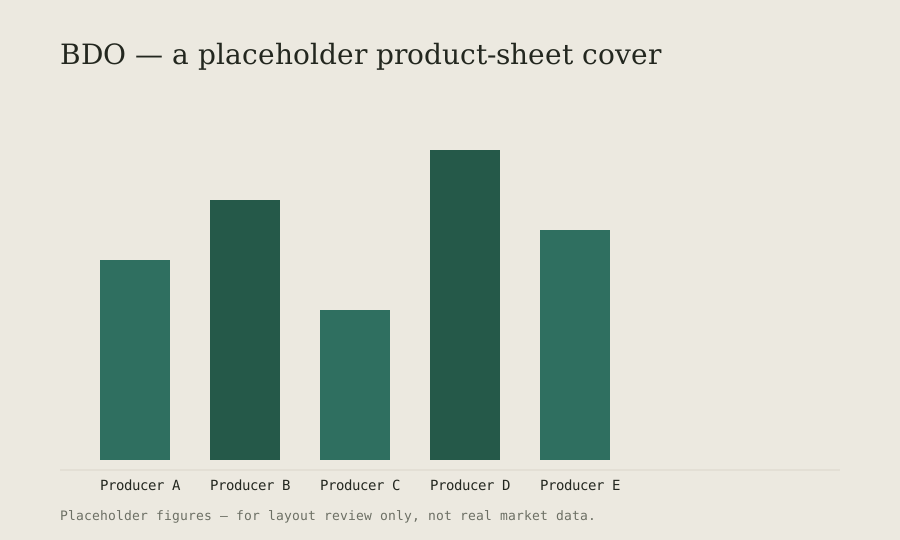
Placeholder text, a cover image and a data table together, built to the same shape as the BDO product sheet shared in the handover — for review before real figures go in.
Since 22 September 2026, a definitive anti-dumping duty has applied to 2-phosphonobutane-1,2,4-tricarboxylic acid and its sodium salt from China, known in the trade as PBTC.
Citric acid and trisodium citrate dihydrate from China have been subject to an EU anti-dumping duty since 2008.
Every morning, I use my Coaching Asia to look at what is moving in Asia and the Middle East and what it could mean for sourcing in Europe.
Anyone sending a first enquiry to Korea tends to make the same experience I did. The enquiry does not fail on price, it lands with the wrong company.
In June, we brought together more than 120 people from the chemical industry in Hamburg. It showed that many people in our industry are interested in open and personal exchange.
A fresh anti-dumping measure rarely closes a trade lane outright — it just changes who can still afford to use it, and that's the part worth watching.
In discussions with chemical producers in China and India, I am almost always shown the same figures: capacity, utilisation and price. But they only show me the production side.
Gulf producers are no longer just exporting on price. Here's what's actually changing, and what it means for buyers used to sourcing from Asia.
For a first-time exporter from China, the Gulf or elsewhere, REACH is usually the first real gate into the European market — here’s what it actually involves.
Leave your email and the next article lands in your inbox — a few times a month, never more.